Greetings, Earthlings...

Welcome to Beyond the Limits of Reason, the meeting point for all things Michael Doubrava.

Michael Doubrava profile

I was born on Earth during the second half of the twentieth century.

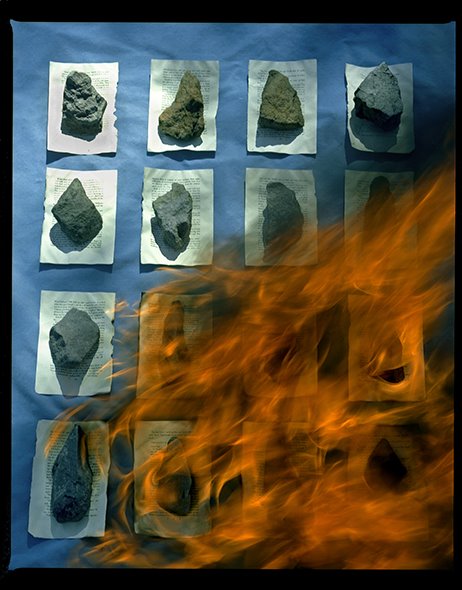
Untitled (San Lorenzo, New Mexico)

Untitled (San Lorenzo, New Mexico)
A metaphor for the conflict between rationality and emotion; betweeen Apollo and Dionysus; between the empirical and the supernatural; between stasis and revolution...

our motto and mission is to

tickle the idiot
rapture the faithful
pity all the ignorant and hateful

illuminate the enlightened
confound the intellectual
with life distilled flood memory's temple
Showing posts with label digitized photocollage. Show all posts

May 4, 2025

God of the Dandelions (April 2025)


A strange realization that this image resembles an interior 'vision' I had days earlier washed over me when I stared at my computer monitor screen, having clicked "save image" hours earlier. I believe I encountered this image in a remarkably specific and visually-particular daydream a few days before I made the in-camera quadruple-exposure that served as the source image of this final version. 

The notion of a species of humans that grew a small jewel or diamond or precious amber or ruby or jade or sapphire or turquoise literally on the skin, embedded on the surface like an indelible tattoo, naturally growing each time an act of true love or true kindness was done from purely selfless, noble intentions. These people who did the most good in society would be notable for their encrusted, bejeweled skin surfaces, like old barnacles on a sunken chest of treasure. 


April 21, 2024

New Work (April 2024)


 This image began as a triple-exposure, which was then duplicated four times and arranged to complete the final work. 

February 23, 2021

Three Different Visual Strategies/Responses to the Same Subject: Orchid

These three photographs were made using the same camera, in the same room, utilizing the same subject: my very patient and always willing subject, the plant I lovingly have named Lazarus, after the biblical figure who rose from the dead. Lazarus the Orchid came into my life  three or four years ago. This orchid has returned from what I believed was death, to bloom and flower again, over and over. This re-flowering, this rebirth, always inspires me to observe and celebrate and create a new round of photographs.

The top image is the most visually conventional, on the surface, yet even it is a couple of steps away from a traditional photograph: looking closely, the viewer detects ghostly double images within the frame.

The second image was made with a pinhole "lens", rather than an actual glass lens. The long exposure time, thirty seconds (due to the tiny f162 aperture through which light strikes the sensor), resulted in a bit of softening of the floral detail.

The third and final image is also a pinhole photograph; it varies from the second image due to a sense of overall Dionysian energy and fecundity, almost from a bug's-eye perspective.


October 27, 2020

Mechanical Flowervine, 2020


 This image began as a series of in-camera multiple exposure photographs. On the day I made these photographs, I utilized my camera's multiple exposure capability and made three exposures on each digital file. Additionally, the camera was rotated to a different position on a circular axis between each exposure (the lens was in the same spot, although the camera body was rotated). These four separate files, each a triple exposure, were combined on a new canvas. This new composite image was then saved, and duplicated in a horizontal reverse. This reverse was then added to the first composite. "A process so simple a monkey could do it!"

October 14, 2020

Exploding Orchidbomb (October 14, 2020)


This image is a composite created from an original single photograph of an orchid. This source image was a multiple exposure of the orchid. This original source image was multiplied into individual identical copies. These nine copies were divided into three sets of three images each; each set was a row of three images in a horizontal line. These sets were either rotated vertically, or left alone. These sets were then arranged on top of each other, with each row laid horizontally upon the row beneath it. These rows were adjusted in Photoshop in layers slightly using the move tool to position them within the compositions vertical axis. A slight amount of blending occurred to smooth out edges, mostly at print output size viewing option.
 

October 4, 2020

Kansas Landscape, October 2020


 The tree which serves as the source image of this photograph stands alone in a carefully manicured suburban housing development. Its powerful, ancient, and mysterious presence does not seem diminished by its mundane surroundings; instead it appears to magnify its weird isolation within a theatrical, scripted space. As I left the golden fields surrounding this titan, I felt a malevolent presence as though this tree, and its family, is not happy with us.

September 4, 2019

August 2019 still-life of flowers morphs into a Baroque design

The original source material being photographed here was a vase of flowers sitting on a dining room table. Long after midnight I decided to make a couple of detail photographs of them. A few days later I "sandwiched" two of them together, making a new image. This image was duplicated four times, and flipped/rotated/reversed and then joined together, making the final image you see here. This image is very fun to look at, very entertaining, very hypnotic.  The central machine-like flower generator in the exact center is matched in weirdness only by the laughing face of the Dionysus-like creature at very top center. Finally, the viewer notices the pale "image" of a child's face emerging out of the center lower pattern as well. This child stares directly out of the frame, meeting the viewer's gaze. This photograph breaks expectations repeatedly, while still utilizing the tried-and-true compositional norms of the very late Renaissance.

July 7, 2019

Baroque Hallucination Fantasia Rapture, Rome, June 2019

This image was created on a swelteringly hot late afternoon in Rome. Walking through the Borghese Gardens, just past the Aurelian Wall portal. I noticed the beautiful trees which are quite different than I am used to, over four thousand miles away. I notice how the tops of the trees stand out against the sky, a kind of loose pattern. After a minute of fumbling around estimating the exposure details. I make two or three photos. One of them gets to serve as the single image from which this "quad" is formed. The Baroque aesthetic was of course coursing through my mind as I worked, and certainly is present in the "imperfect pearl", Baroque compositional design.
When I look at this creation, I see a delightful floating garden in the sky, upon which one might pleasantly, if carefully, stroll.


May 17, 2018

Star Map, May 2018.

This is an image of a supernova at the center of the universe. An exploding star: sending forth cosmic elements which will eventually form new planets and new species of life. And then, after the expanding blossom of the explosion recedes, the dying star will collapse and become a black hole, receding inward and consuming all that surrounds it.

This photograph is a combination of many individual photographs; using my camera I photographed many exposures of the floor of a chapel within Rosehill Cemetery in Chicago. Next, I combined these images into a single horizontal panorama. This new panorama of the floor in front of me, became my new "master": it was then repeated numerous times, and half of these were reversed, like mirror images. All of these images were then collected into one "canvas" and digitally "stitched" together using Photoshop.

April 11, 2018

Baroque Automaton, April 2018

This image is an imaginary re-creation of a Baroque-era "automaton", a term once used to describe a "mechanical-man" (or in this case, a mechanical-woman). Automatons were essentially puppets or proto-robots, powered by wind-up, clockwork-like mechanisms.  These complex productions of engineering and design were handmade by highly skilled craftspeople, and were considered valuable treasures, much sought after for display in the collections of curiousities which fashionable nobles and wealthy merchants curated to delight their peers.
I conceived of this automaton as being in the collection of a Spanish nobleman, circa 1600. Constructed from plates of silver which were looted from Mexico, this mechanical-elf would dance and sing when its' internal mechanism was wound and then released.  This 'renaissance-robot' would sing Andalusian and Catalonian folk songs, while dancing a rudimentary and primitive version of the dance now termed "flamenco." The halls of the royal palace echoed with the startled voices of the assembled audience, the pounding of the automaton's heavy metal boots, and the eerie hollow voice as she sang her sad songs.
This photograph is made entirely from a single source image which has been repeated over and over, at different sizes. The source image, which can also be seen here, is a photograph of a piece of metal which was found lying in the middle of a residential street in Chicago. That sad bit of 21st century detritus has here been elevated into an example of 15th century high-technology.

January 15, 2018

As the Old God Collapses, the New God Emerges, January 2018


"Nothing is new under the sun." Whether the subject is religion, science, or art, all new ideas emerge from the ones left behind. Knowledge, like a river, flows forward from a previous source. New civilizations grow from the cities preceding them; the burnt ashes of forgotten or dying cultures can feed and fertilize new growth. Consider the truth of this statement and remember it as you look at this collection of photographs I have entitled "As the Old God Collapses, the New God Emerges."

This visible, "natural" world we spend our days in is a reflection of a greater reality. As Manly P. Hall stated in his book The Secret Teachings of All Ages (first published in 1928): "The physical nature of the universe is receptive; it is a realm of effects. The invisible causes of these effects belong to the spiritual world. Hence, the spiritual world is the sphere of causation; the material world is the sphere of effects; while the intellectual - or soul - world is the sphere of mediation."

The artist can be a mediator between these spheres, creating images which are reflections and transmissions from a greater reality beyond the clouded spectrum of everyday, half-conscious life.

These images were made from a single double-exposure. In other words, two distinct photographs were combined to create a new source image.

While visiting a large greenhouse/conservatory, I made two photographs. The first photograph was a close-up photo of a large, tropical leaf. The next image was a photo of a different plant, from a greater distance. These two photographs were combined. This new double-exposure became the new source image from which this series was created.


November 2, 2017

Identical Twins (Fullerton Avenue Elevated Platform, Chicago), October 2017

I made the source photograph for this image while riding the Chicago Transit Authority's red line commuter train. As we rolled into the platform at Fullerton Avenue, I quickly made a few photographs, through the window, of the people waiting outside for the train doors to open.

The original image was simple to create, using a typical DSLR ("dx" format) and a 50mm lens. This 'source' image was duplicated four times, and then digitally manipulated in Photoshop, resulting in this final image.

Despite the mundane nature of the everyday moment which was initially recorded, this image illustrates the hazards of depending upon photography as a medium conveying empirical truth.

My original photograph of a De Paul University student waiting for a subway train has morphed into an image of a pair of identical twins who serve as gatekeepers of a private garden. The viewer can examine their features and sense that the twins have contrasting personalities.

October 15, 2017

The End of the World (Jerusalem), 2017

It was high noon, and the sun radiated glare and heat as I walked the perimeter of Jerusalem's walled Old City. I was dazzled by the intense light of August which reflected off the stone surfaces; I was intimidated by the sense of history and ancient time which emanated from these same stone blocks and buildings. It seemed as though different points in historical time were overlapping and converging, within this moment.

When I saw the dome of the Al-Aqsa mosque, I raised my camera. Using a wide-angle lens, I quickly made three photographs of sections of a corner of the ancient city wall; the mosque's dome was visible in the distance along the edge of the frame. Lowering the camera, I turned and retraced my steps, eager to get under some shade, and shelter from the sunlight. I gradually made my way back to more familiar surroundings.  It was a long, slow walk on a dry and dusty day.

A few weeks later I returned to these three separate, detail images.  I decided to stitch them together to form a single photograph, a vertical panorama, of this particular view of the wall. This single component, this new panorama, is the "building block" from which the rest of the image was constructed. After a few duplications and rotations, reversals and pairings, this composite image emerged.

This image reminds me of 19th century photographs by the likes of Maxime Du Camp or Gustave Le Gray, and the drawings of Piranesi. This is, certainly, a photograph made in Jerusalem; but it is also a representation of an Imaginary Jerusalem.  In this regard it follows in the great tradition of artists and pilgrims alike projecting preconceptions on the surface of this great city. The Temple Mount figures significantly in the endtime scenarios embraced by Abrahamic faiths, and this photograph resonates with those religions' scenarios of The End of the World, which are predicted to occur within this very cityscape.

Looking for more?

You can access more imagery by clicking on the phrase above which says"older posts". Many additional works can be viewed dating back to the earliest posts which initiated this blog.